
Na Psicoterapia Sistêmica as fases do desenvolvimento Psicossexual
são distribuídas de forma diferente da Psicanálise.
In Freud’s school, it is as follows: oral phase/anal phase/phallic phase/latency period and genital phase.
Systemic psychotherapy is based on Freud’s theory with some modifications: oral phase/anal phase/phallic phase and restart in pre-adolescence of the oral phase/anal phase/phallic phase and genital phase.
Another difference is that systemic psychotherapy believes that psychosexual development, like other types of development, is influenced by the interaction of parents and that parents, in turn, are influenced by family and transgenerational interactions.
Let’s take a look at the views of these schools.
PSYCHOANALYTICAL VIEW ORAL STAGE
–
0 to 18 months
The child is egocentric, narcissistic and sees the mother as an extension of himself (as if she were an appendage). It is as if the world were him or revolved around him.
Here we have primary dependence: we literally need our mother to survive physically and emotionally.
And it is the mother who will promote or help to break this egocentricity.
The first separation we experience is at birth. We leave the nourishment and warmth and are ‘expelled’.
We are born undergoing the process of separation.
Some children resist this process of separation because they perceive that they are not wanted (the non-desire for their existence). These children therefore have less physical and/or emotional resilience. They are born already depressed or with little drive to live.
The second separation occurs when the child begins to see the mother as ‘another’ person.
This separation occurs when the mother has reasons to return to other roles in her life: woman, wife, professional, social.
Many women ‘cling’ to the role of mother, perhaps because they feel powerful, recognised and loved. The child brings the life that she does not have. At that moment, she will have a ‘unique’ child and then she will be able to ‘keep’ the other children one after the other.
The separation process occurs together with the end of breastfeeding. When the mother begins to replace the breast, the child and the mother experience a lot of pain. At that moment, the child experiences a lot of hatred, frustration, anger, anguish, pain, anxiety, and helplessness (depressive phase, described by Melaine Klein). And the mother feels anxiety and distress, with the possibility that the child no longer needs her.
Melaine Klein: in this separation, the child experiences the splitting of the breast into a good breast and a bad breast. Example: when the mother leaves (bad breast), the anxiety is very strong. If the child knows that she will return,
he learns to wait. If she is too late or even if she returns but is not available, the child experiences feelings of abandonment and rejection and becomes very anxious – schizo-paranoid position. But if only the good breast is activated, pure dependence or symbiosis is created.
*** Todo esse processo é inconsciente e o ego começa a estruturar quando ocorre a separação mãe-filho.
ANAL STAGE
– from 18 months to about 3 and a half years
Sphincter control. Here, the child will learn boundaries.
There are two movements: expulsion and retention.
Retention: having/holding back/controlling/preserving.
Expulsion: giving/eliminating/excluding/separating.
Some children take time to hold back (they pee and poo in their trousers) and some children hold back (they go days without pooing).
Here we are learning balance in giving and receiving, internalising NO.
It was introduced in the first phase and here it is definitively introjected = formation of the SUPEREGO.
The no
is accompanied by tests. Example: “Boy, don’t put your finger there!” He goes and tries. And the more he distrusts the love of his father and mother, the more he tests this authority. In reality, the child wants to see if he can “trust” these people. He is testing consistency.
Here we have the beginnings of the Oedipus complex: the child tests the consistency and authority of the parents and actually tests LOVE. He also tests the couple’s relationship, whether it is consistent, whether the couple has affinity, whether they are really together or not. In this way, the child will learn what authority is. The imbalance is the resistance to coming out of narcissism, ego, and dependence.
PHALLIC STAGE –
approximately 3 to 6 years old.
If everything is happening in a functional way, the child ‘understands’ that the mother has another ‘object of desire’ who is his father.
At this point, ‘triangulation’ or the ‘Oedipal’ issue will occur.
SYSTEMIC VISION FUNCTIONAL OEDIPUS .png) COMPLEX
COMPLEX
The child ‘seduces’ the mother.
This is where the first clash between father and son occurs.
It is the father who makes the cut, and for this to happen, it depends on the relationship established between the couple.
This is the formalisation of the INTERNALISED FATHER.
This is where male identification takes place: the child wants to become as powerful as his father in order to have a woman like his father’s.
This requires a father who is comfortable in his male role and a healthy couple.
** If this mother becomes a widow, for example, another man (uncle, godfather, grandfather, mother’s boyfriend) can facilitate this cut. This cut must be made by a man.
Dysfunctional Oedipus complex
1st case
.jpg)
This is a dysfunctional couple: this man has no desire for or satisfaction with this woman.
He can act as father, son, enemy, partner, etc.
When this son seduces the mother, she appreciates him because her husband does not satisfy her desires.
So, she chooses her son as her ‘partner’ and her husband does not make the cut between this mother and son.
The woman ‘promotes’ this son in place of her ‘husband’ (replacing the marital lack).
Here, the son remains fatherless. Hypothesis
This son may have many difficulties in relationships and in trusting another woman, remaining single to take care of his mother.
It may also happen that the mother does not despise the father, even if this man does not satisfy her emotional needs, and so she remains with two men
(father and son).
This son may marry, but only a woman chosen by his mother, who will not take her away from him. She must be a woman as strong as his mother, but who, as long as she is alive, does not threaten her and who, when she dies, will take care of her son as she did. This man who is with a woman not chosen by his mother ‘does not perform’ in bed or has little desire for this woman because he feels he is betraying his mother. Example: Film – Oedipus Devastated
2nd .jpg) case
case
The first tendency is for the mother to make her son her ‘husband’.
This mother plays two roles: that of her son’s wife and that of her son’s father, wanting to teach him how to be a man.
It may happen that this son feels anger towards women (and is not homosexual). He has sex with women, but does not form attachments, because he is married to his mother (he remains a bachelor).
HYPOTHESIS OF HOMOSEXUALITY: The son will seduce his mother and there is no one who can interrupt this relationship (a man), so he has no choice but to identify with his mother.
He creates a resistance towards women, because it was a woman (his mother) who tried to teach him to be a man.
This mother, in fact, finds it very positive that her son does not have ‘another’ woman. He can also have sex with all the men he wants, but never with ‘another’ woman.
3rd case

This couple is happy to be this way: the father (male gender, female role) and the mother (female gender, male role).
There is no anguish or pain here. They are satisfied with their roles.
So, instinctively, the son seduces the mother and the father does not intervene.
It is the mother herself who does so, because she has the male role in the couple and because she already has her boyfriend (who is her husband).
Thus, the mother does not prevent the son from identifying with the father, because the couple has a good emotional relationship. This son identifies with his father and will seek a strong woman like his mother.
The son will not be homosexual, but he will be a more sensitive man (like his father) and will live as his parents live happily! This family is not considered dysfunctional.
4th case
.png)
This couple experiences this role reversal, but the woman is very annoyed and says, ‘Your father is an idiot!’.
Therefore, the mother does not
allow her son to identify with his father. She subtly says, ‘Don’t be like your father, who is weak! Be like me, who am strong!’.
In this case too, homosexuality is a strong possibility.
So, he is a man (male gender), his identification role (which is his mother) is male, he will look for a man in the female role (like his father). That is, he will look for a female figure in the male gender, because the female is in the father (in the man).
On male homosexuality:
Homosexuality (both male and female) is a controversial topic, and there are no rules such as: when this happens, then homosexuality occurs. Each case is unique.
Ninety-six per cent of homosexuals are male, with a male role and homosexual desires and practices.
These homosexuals do not want to stop being men. They want to be men, they just desire another man.
Only 4% of homosexuals suffer from gender disorder. In other words, they are men who want to be women.
They feel like women, they do not fit in internally and are therefore more aggressive.
Here the suicidal component
is very strong, because they are very depressed or have strong depressive traits.
Others become psychotic because they cannot cope with the harsh reality (male body, feeling of being a woman).
Cases of gender disorders (transvestism, transsexualism, bisexualism, etc.) are even more specific cases and each of them needs to be better understood.
For example: if a person with gender disorder undergoes surgery to change sex, this does not mean that they will make a heterosexual choice. It could also be a homosexual option.
The vast majority of homosexuals are married and have children.
These men seek out transvestites (who are the stereotype of women), but in bed they may take on the passive role. They have heterosexual practices but homosexual desires.
Many homosexuals are macho and hate gay men. They never admit their homosexuality nor are they aware of it.
Homophobia: fear of homosexuality.
In latent homosexuality, there may also be sublimation,
which transforms what is considered destructive into something constructive, such as: masseur for a football team; army general; barber; urologist, proctologist; etc. This does not mean that men in these professions are latent homosexuals. It only means that these professions can bring these men closer to others.
FUNCTIONAL ELECTRA COMPLEX – from approximately 3 to 6  years of age
The little girl seduces her father, and it is the mother who interrupts the relationship (if the couple is functional).
The woman says to her daughter: “He is your father and he is my husband!”.
At first, there is a quarrel between the daughter and the mother, but later the daughter forms an alliance with the mother (she puts on lipstick, wears her mother’s shoes).
This is where the Electra complex ends.
In the Oedipus complex, the son’s first love is heterosexual (the mother) and he competes with his father.
In the female case (Electra), the first love is the mother. At around the age of three, she instinctively falls in love with and seduces her father, betraying her first love, who is her mother.
This is where a sense of guilt arises that all women carry with them for the rest of their lives.
Women always feel a great sense of guilt towards their mothers, finding it very difficult to have or be different from their mothers.
Many women are unable to free themselves from this debt, from this sense of guilt, and often seek a relationship that is just as dysfunctional or difficult as that of their mother.
As therapists, we must help our clients make two ‘separations’: first from their father and then from their mother.
Dysfunctional Electra Complex
Case 1
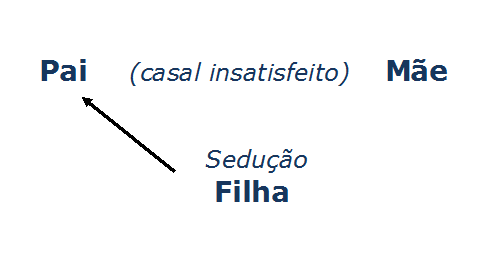
This couple has already admitted that their relationship is unsatisfactory.
Here, the daughter will seduce the father and the mother will not intervene because she does not care (in fact, she even finds it positive).
He also finds it excellent, and this daughter becomes the daughter/wife, the woman that this father/man wanted to have.
Here, the daughter remains fatherless, and sexual involvement may occur, leading to physical contact.
What may happen to this daughter in the future:
She may remain unmarried for her entire life because she is already married to her father.
An incestuous emotional or physical relationship with her father may develop.
She may marry an older man (representing the ‘father’), making a transfer.
She may marry a homosexual, who will not compete with her father, who will continue to be her ‘great love’.
She may remain single (married to her father), taking on all the responsibilities towards her other siblings, and her mother herself would become her daughter.
It could also happen that the mother hates this daughter and that they become rivals (Oedipal dispute).
The mother punishes the daughter for the rest of her life because she is ‘Daddy’s little girl’. In other words, the daughter whom the father loves more than his wife will be hated by the mother. And so, this daughter remains fatherless and motherless.
Note:
this father may also have a harem of daughters/girlfriends, each with a different role in the system.
2nd case
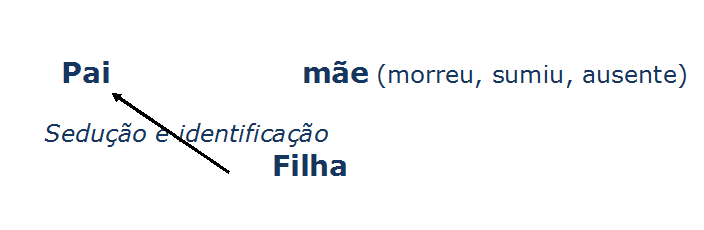
This daughter becomes the father’s wife and therefore does not allow any other woman to approach him.
She will identify with her father because there is no woman to act as a mediator.
She may become very masculine, and if there is another daughter, she may become very feminine, and there may also be a third sister who is the daughter of both.
This can lead to latent or even emerging homosexuality (seeking a relationship with another woman to replace the mother she never had).
Observation: there is the homosexual woman who loves her father and hates her mother, but there is also the one who hates her father and defends her mother, who is nullified and subjugated to that father.
3rd case
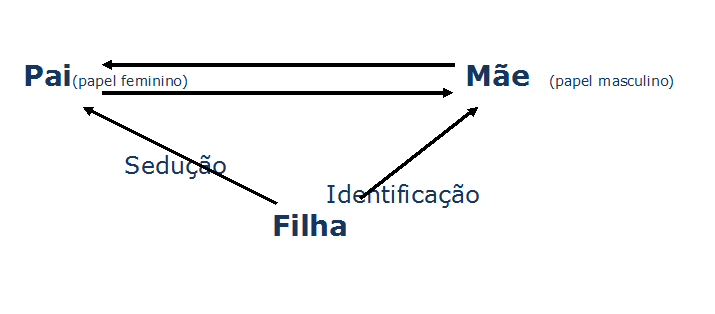
Here the couple is incomplete but happy.
So the daughter initially seduces her father, then the mother cuts her off and she identifies with her mother, who has the male role. In this way, she can look for a more sensitive man like her father.
But if the couple is incomplete and unhappy, the following may happen: the daughter seduces her father, the mother may cut her off but always say: ‘Your father is an idiot!
This is because this mother is probably very harsh and envious of her husband’s affection. In this way, the daughter will find it difficult to value men.
The mother was not homosexual, but the daughter could become so, seeking a more passive partner.
She could live out homosexuality for her mother and for herself.
Texto organizado para fins didáticos por: Jaqueline Cássia de Oliveira - 2001
Usado em cursos de formação em Terapia Familiar Sistêmica
Psicóloga - PUCMG - 04/7521
Psicoterapeuta Familiar Sistêmica - Brasil